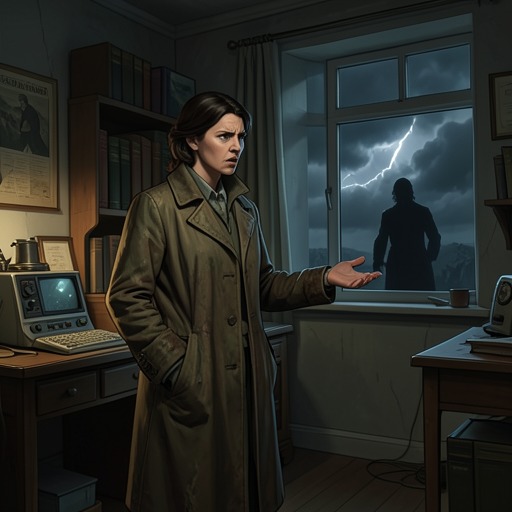
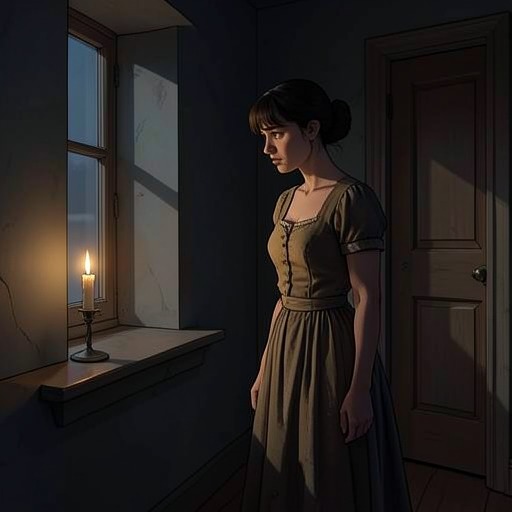
Tore’s return to Elvy’s home
Handling the UndeadTore’s return to Elvy Lundberg’s home brings the returned dead into the closest possible range: not a public square or an institution, but the house where his wife and granddaughter are sleeping. At first Elvy hears only scratching at the front door. When she opens it, her husband—dead for three years—stands on the steps in his best suit, silent and altered. The encounter makes recognition unavoidable while withholding the ordinary signs that would make reunion possible: Tore is present, but he does not answer, look at Elvy, or respond to her fear for Flora.
The Knock and the Recognition
The scene begins after Elvy has turned on her bedside lamp and is considering whether to try another session with Grimberg. At twenty past twelve, scratching interrupts the quiet. She initially imagines an injured person, then opens the door. The delay matters: the sound is first treated as a small, uncertain disturbance, something that might have an ordinary explanation. Instead, it announces the return of someone whose death Elvy had already confirmed by every available means.
Tore wears his best suit, but illness has changed how it fits. He lost about twenty kilos in his final years, and the gabardine hangs loosely from his shoulders. He stands with his arms dangling; his bare, white feet and untrimmed toenails draw Elvy’s attention. These concrete details make the return less like a restoration than the arrival of a body carrying the marks of illness and neglect. The suit signals a familiar person and a life shared with Elvy; its poor fit, like his feet, immediately unsettles that recognition.
Elvy’s first response is not terror. She feels surprise and exhaustion, and asks what Tore is doing there. His eyes are open, but there is no gaze in them. Elvy knows the blankness from the years when she had already encountered his absent attention, but now it is more frozen and lifeless. She understands that the figure is Tore, yet thinks of him as a doll. The contradiction defines the encounter: the returned figure is unmistakably her husband and, at the same time, gives her no evidence of the responsive person she expects.
A Body Moving Through the House
Tore does not wait for an invitation or answer Elvy’s question. He takes several steps and enters the house. As he passes her, she smells a chilled hospital odor—disinfectant and starch, with something sweeter beneath it. Elvy pulls herself together, grips his shoulder, and asks again what he is doing. He pays no attention. His steps are jerky, each one seeming to require effort, but he continues toward the other bedroom, his room.
The movement sharpens the shock. Elvy realizes that she has not seen Tore walk for seven years. He now moves stiffly, as if unused to his newly returned body, yet he goes directly toward Flora, who is sleeping in that bedroom. His intention is not explained; the scene gives no account of what he wants. What it does show is the effect of his movement on Elvy: she grabs both his shoulders from behind and urgently tells him that Flora is asleep and to leave her alone.
When Tore turns, Elvy tries to stop him with the force of her gaze, as she had once tried to make him stop moving and start talking. This time, her look cannot hold him. His sunken face and hollow cheeks show the loss of weight, but he is still markedly stronger than she is. There is neither emotion nor recognition in his eyes. Elvy backs away, defeated; the limits of her former ways of reaching him become physical as well as emotional.
Flora Witnesses the Return
Elvy tries once more to seize Tore, but the bedroom door opens and Flora comes out. Seeing him, Flora whimpers, throws herself aside, and crawls toward the balcony door after stumbling over an armchair. Tore appears not to notice her and enters the bedroom. His advance has therefore already brought the danger Elvy feared into the open: Flora is awake and has seen the silent figure, while he continues to move without acknowledging either woman.
Later, Flora is still sitting on the floor in the same position. Elvy is unable to comprehend Tore’s return, but her attention turns to her granddaughter, whom she fears the experience may overwhelm. Flora asks what he is doing. Elvy takes the question as evidence that Flora has not completely withdrawn from the moment; she is still interested in what is happening. Elvy answers, “I think,” that he is pretending to be alive. The phrasing gives the impossible event a temporary, practical description without pretending to explain it: Tore is there, and his body is acting, but Elvy cannot make that action mean that he has truly returned to ordinary life.
There is no easy way to remove Flora from the house. The buses have stopped, and Margareta and Goran are in London. Elvy does not call her daughter: she expects Margareta’s distress to become overwhelming, with rapid, high-pitched speech and even clawing at her face if anything goes wrong. These circumstances leave Elvy to manage the immediate crisis herself. Her role in the scene is divided between trying to restrain Tore and trying to keep Flora present and safe.
The Body’s Condition Becomes Public
The return does not end with Tore entering the bedroom. When paramedics later bring him back, their controlled revulsion signals the condition they have encountered. The front of his shirt is damp and spotted with yellowish fluid; a smell of rotting organic matter surrounds him. He has started to defrost. The hospital-like chill of his first appearance has thus given way to visible and olfactory evidence of bodily decay.
Bernt begins to identify what they are seeing, but Elvy supplies the name: Tore. That naming closes the distance between a disturbing body and the person she recognizes, without cancelling the body’s condition. The scene’s decisive contrast persists to the end: Elvy refuses to treat the returned figure as an anonymous object, yet neither recognition nor the fact of his movement restores the husband who could answer her. Tore’s return is at once a homecoming and a rupture in the meaning of home, as his body crosses the threshold while the familiar relationship cannot simply resume.